

One Email Almost Cost This Company Everything
It started with a single phishing email. An employee at a mid-sized accounting firm clicked a link, entered their credentials, and within hours, attackers had full access to the company’s client database social security numbers, tax records, financial histories. The breach wasn’t discovered for 11 days.
The total damage? Over $400,000 in legal fees, regulatory fines, and lost clients. And that was considered a “small” incident by industry standards.
This isn’t a horror story meant to scare you. It’s Tuesday for cybersecurity professionals.
The hard truth is that cyber threats have evolved from a niche IT problem into one of the most serious business risks companies face today. And yet, most businesses are still operating without proper cybersecurity services in place the digital equivalent of leaving the front door wide open. Professional cybersecurity services aren’t a luxury anymore. They’re a core business function that every company regardless of size urgently needs.
Why Businesses Actually Need Cybersecurity Services
Let’s be direct: your business is a target. Not because you’re special because you exist.
Modern cybercriminals don’t just go after Fortune 500 companies. They run automated tools that scan thousands of networks simultaneously, looking for any weakness. If you have data, you have value. If you have systems, you have attack surface. That’s precisely why investing in business cybersecurity solutions is no longer a question of “if” but “when.”
Here’s what businesses are actually up against right now:
Ransomware has crippled hospitals, law firms, manufacturers, and logistics companies. Attackers encrypt your files, then demand payment often $50,000 to $2 million to give them back. Businesses without cybersecurity services in place are left negotiating with criminals or rebuilding from scratch.
Phishing attacks remain the #1 entry point for data breaches. Employees receive convincing fake emails impersonating banks, vendors, or even the CEO, tricking them into handing over credentials or triggering wire transfers.
Data theft is quieter and often more dangerous. Competitors, criminal organizations, or rogue insiders may extract sensitive customer data, trade secrets, or financial records over months without triggering a single alarm.
Business Email Compromise (BEC) cost companies over $2.9 billion in reported losses in 2023 alone, according to the FBI. This is fraud that plays out entirely through email no malware required.
The business impact goes beyond the immediate financial hit. You’re also looking at regulatory fines under HIPAA, GDPR, or PCI-DSS, customer trust that takes years to rebuild, and in some cases, business closure. Cyber risk protection for companies isn’t about paranoia it’s about survival.
Key Cybersecurity Risks Most Companies Are Quietly Ignoring
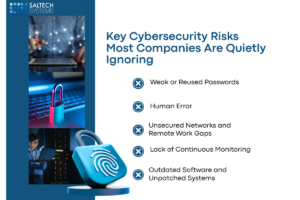
The most dangerous vulnerabilities in most businesses aren’t exotic zero-day exploits. They’re embarrassingly mundane. This is exactly why dedicated cybersecurity services exist to catch what internal teams miss or don’t know to look for.
Weak or Reused Passwords “Password123” and variations remain among the most commonly used credentials in corporate environments. When employees reuse the same password across email, company systems, and personal accounts, one compromised account becomes a skeleton key.
Human Error Studies consistently show that over 80% of data breaches involve a human element. Clicking the wrong link, misconfiguring a cloud storage bucket, or forwarding a file to the wrong email address these aren’t IT failures, they’re training failures that IT security for businesses can directly address.
Unsecured Networks and Remote Work Gaps Post-pandemic, remote and hybrid work became permanent for many teams. But most businesses never properly secured home networks, personal devices, or VPN access points. Every remote laptop is a potential entry point.
Lack of Continuous Monitoring Most small and mid-sized businesses operate on a “hope nothing happens” security model. There’s no one watching logs, flagging anomalies, or detecting the slow, patient movement of an attacker who got in three months ago and is quietly mapping your systems.
Outdated Software and Unpatched Systems Attackers actively scan for known vulnerabilities in outdated software. A patch that’s been available for six months and hasn’t been applied is a wide-open door with a neon sign above it. Reliable cybersecurity services include patch management as a standard offering because most businesses simply don’t do it consistently on their own.
10 Practical Ways to Strengthen Business Security Right Now
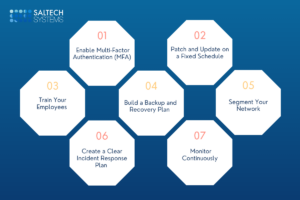
You don’t need a massive budget to dramatically reduce your risk. These are the moves that actually matter and what quality cybersecurity services help you implement correctly:
1. Enable Multi-Factor Authentication (MFA) Everywhere This single step prevents the vast majority of credential-based attacks. Even if an attacker has your password, they can’t get in without the second factor. Turn it on for email, cloud platforms, and any remote access system no exceptions.
2. Patch and Update on a Fixed Schedule Build a regular routine weekly or bi-weekly to update operating systems, software, and firmware. Automate where possible. This neutralizes a huge percentage of known attack vectors before attackers can exploit them.
3. Train Your Employees Like It Matters Security awareness training isn’t a one-hour annual checkbox. Run phishing simulations. Hold short monthly briefings. Your people are either your biggest liability or your first line of defense cybersecurity services that include employee training turn them into the latter.
4. Build a Backup and Recovery Plan You’ve Actually Tested Backups that haven’t been tested are just assumptions. Have offline and offsite copies of critical data. Know exactly how long recovery takes. If ransomware hits tomorrow, your ability to restore operations in hours versus weeks is entirely determined by the plan you build today.
5. Segment Your Network Don’t let every device on your network communicate with every other device. Separate guest Wi-Fi from internal systems. Keep financial systems isolated. If an attacker gets in through one machine, segmentation stops the spread.
6. Monitor Continuously or Hire Someone Who Does Attacks rarely happen at 2:00 PM on a Tuesday they happen at 2:00 AM on a holiday weekend. Partnering with managed security services ensures someone is always watching, always responding, even when your team is offline.
7. Control Who Has Access to What Not every employee needs access to every system. Apply the principle of least privilege give people access only to what they need for their role. Reducing access points reduces your attack surface significantly.
8. Conduct Regular Vulnerability Assessments You can’t fix what you don’t know is broken. Professional cybersecurity services run periodic scans and assessments to find weaknesses before attackers do. Think of it as a health checkup for your entire IT environment.
9. Create a Clear Incident Response Plan Document exactly what happens when a breach is detected who gets notified, what systems get isolated, who talks to clients, who contacts regulators. Having this plan in writing before you need it is the difference between a managed crisis and a total disaster.
10. Review Third-Party and Vendor Access Your vendors may have access to your systems, and their security posture becomes your risk. Audit third-party access regularly and ensure vendors meet minimum security standards before connecting to your environment.
How Cybersecurity Services Protect Your Business End-to-End
Here’s where professional cybersecurity services move from “nice to have” to genuinely business-critical. This is what a quality provider delivers:
24/7 Threat Monitoring and Detection Managed security services deploy Security Operations Center (SOC) teams that watch your environment around the clock. They identify threats in real time not after a breach has happened and you’re filing an insurance claim.
Incident Response When something does go wrong and statistically, something will having an incident response team ready to execute is the difference between a contained event and a catastrophic one. Response time is everything, and cybersecurity services with dedicated response teams dramatically reduce damage and recovery time.
Vulnerability Assessments and Penetration Testing Professional cybersecurity services include regularly testing your own defenses. Ethical hackers attempt to break into your systems the same way real attackers would, giving you a clear picture of exposure before criminals find it first.
Data Breach Prevention and Compliance Support If your business handles regulated data patient records, payment information, personal customer data you have legal obligations around how it’s stored and protected. Cybersecurity services help you meet those obligations and avoid the costly fines that follow non-compliance.
Strategic Security Planning A good cybersecurity partner doesn’t just react to threats they help you build a long-term security roadmap. As you add employees, systems, and data, your business cybersecurity solutions should scale with your growth.
When Should a Business Invest in Cybersecurity Services?
The honest answer: before you think you need to.
But here are the clearest signals that it’s time to act:
- You’ve experienced a breach, attack, or suspicious activity even a minor one
- Your team is fully or partially remote and security practices haven’t been formalized
- You’re handling increasing volumes of customer data, payment information, or sensitive records
- You operate in a regulated industry (healthcare, finance, legal, education)
- You’ve grown past 10 employees without a dedicated IT security function
- Enterprise clients are requiring security certifications before signing contracts
Small businesses shouldn’t assume they’re off the hook. In fact, small businesses are disproportionately targeted precisely because attackers know defenses are weaker. Managed security services exist specifically to give smaller organizations enterprise-level cyber risk protection at a fraction of the in-house cost.
Larger enterprises face more complex challenges third-party vendor risk, regulatory scrutiny, larger attack surfaces. For them, the question isn’t whether to invest in cybersecurity services but how comprehensively.
Common Mistakes Businesses Make With Cybersecurity
“We’re too small to be a target.” This is the most dangerous misconception in data breach prevention. Attackers don’t pick targets by size they pick by ease of access. A small business with weak defenses is far more attractive than a large enterprise with strong cybersecurity services in place.
Treating security as a one-time setup. Buying a firewall in 2020 doesn’t mean you’re secure in 2026. The threat landscape changes constantly. Without ongoing cybersecurity services, yesterday’s protection becomes today’s liability.
Skipping employee training. Technology alone cannot protect you from human behavior. The most sophisticated security stack won’t stop an employee from clicking a phishing link they haven’t been trained to recognize.
No incident response plan. Most businesses discover they have no plan only after they desperately need one. Building a response plan mid-attack is like reading fire escape instructions while the building burns.
Assuming their IT vendor handles security. General IT support and cybersecurity services are entirely different disciplines. Your IT vendor keeping systems running doesn’t mean they’re actively monitoring threats, testing defenses, or managing your security posture.
Conclusion: Cybersecurity Services Are the Best Investment Your Business Can Make
The companies that treat cybersecurity services as an expense to minimize are the ones that end up on the front page of the news for the wrong reasons.
The companies that treat cybersecurity as an investment in customer trust, operational resilience, and long-term reputation are the ones that continue to grow.
In a world where a single breach can unravel years of hard work, professional cybersecurity services aren’t optional. They’re the foundation every modern business runs on. The cost of prevention will always be less than the cost of recovery.
Start with an honest assessment of where you are today. Identify your biggest gaps. Find a cybersecurity services partner who understands your business not just your technology. And act before an attacker forces your hand.
Frequently Asked Questions (FAQ)
Why do businesses need cybersecurity services?
Businesses face constant threats from cybercriminals targeting their data, finances, and systems. Cybersecurity services provide the expertise, tools, and 24/7 monitoring needed to detect and prevent these threats before they cause financial loss, downtime, or reputational damage. Without professional support, most businesses lack the capacity to defend against today’s sophisticated attacks.
What risks do companies face without cybersecurity services?
Companies without proper cybersecurity services are exposed to ransomware that can halt operations entirely, data breaches that expose customer and financial information, phishing fraud, and regulatory fines for failing to protect sensitive data. Beyond the financial damage, businesses risk permanent loss of customer trust and potential legal liability.
Are cybersecurity services necessary for small businesses?
Absolutely. Small businesses are targeted more frequently than large enterprises because attackers know defenses are typically weaker. A breach can be proportionally more devastating for a small business. Managed security services are specifically designed to give smaller organizations professional-grade cyber risk protection at a budget-friendly cost.
How do cybersecurity services protect company data?
Cybersecurity services protect company data through continuous monitoring, encryption of sensitive information, access controls, regular vulnerability assessments, and rapid incident response. They also ensure businesses meet compliance requirements under GDPR, HIPAA, and PCI-DSS protecting both your data and your legal standing.
What is included in managed cybersecurity services?
Managed cybersecurity services typically include 24/7 network monitoring and threat detection, vulnerability scanning, penetration testing, firewall and endpoint management, incident response, employee security training, compliance support, and regular reporting. The goal is always continuous, proactive data breach prevention not reactive damage control after something has already gone wrong.