


If you’re a small business owner, you’ve probably asked yourself the same question dozens of times: should I hire an in-house IT person, or is it smarter to outsource to Managed IT Services?
It’s a fair question and the honest answer is that most business owners are comparing the wrong numbers. They look at one salary versus one monthly invoice and call it a day. But the real comparison goes much deeper than that, and getting it wrong can cost you tens of thousands of dollars a year.
At Saltech Systems, we quote this comparison for small businesses in Ames and Plano every month, so here’s what we actually see not just industry averages.
A Real Example: What We Quoted a 22-Person Client
Earlier this year, a growing professional services firm came to us weighing the same decision. They had one in-house IT hire on staff, fully loaded cost (salary, benefits, software licenses, training) running close to $95,000 a year and when that person took two weeks off, support tickets simply piled up until they got back.
We built them a managed IT plan covering help desk support, continuous monitoring, patch management, and baseline cybersecurity for their 22 employees. Their new monthly cost landed well below what they were paying for one person alone while adding a full bench of specialists and built-in coverage for vacations, sick days, and turnover. That’s the comparison that actually matters: not salary vs. invoice, but total coverage vs. total cost.
What Do Managed IT Services Actually Include?
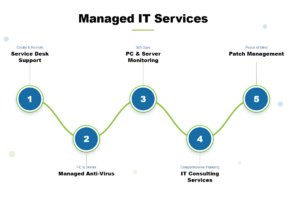
Managed IT Services means outsourcing your day-to-day technology needs to a dedicated outside team instead of hiring someone in-house. That typically covers five core areas: onsite and remote service desk support for when things break, managed anti-virus protection across every PC and server, round-the-clock (365-day) PC and server monitoring to catch issues before they become outages, ongoing patch management to keep systems updated and secure, and comprehensive IT consulting to plan for what’s next. Instead of relying on one generalist who’s out sick, on vacation, or simply doesn’t know a particular system, you get a full bench of specialists covering networking, security, cloud, and support all at once.
The Real Cost of an In-House IT Hire
On paper, hiring one IT employee looks simple. In reality, the salary is just the starting point. A mid-level IT generalist typically earns a base salary that, once you add health benefits, retirement contributions, paid time off, training, certifications, and the software licenses they need to do their job, adds up to a much bigger number than the offer letter suggests.
Then there’s the risk. One person means one point of failure. If they’re out sick, take vacation, or leave the company, your entire operation is exposed until you find a replacement and recruiting a new IT hire typically takes months, not weeks.
The Real Cost of Managed IT Services
Managed IT providers typically bill on a simple per-user, per-month model. For a small business, that monthly fee covers help desk support, ongoing monitoring, patch management, and core cybersecurity protection delivered by a full team rather than one person.
Here’s a simplified side-by-side look at what small businesses are typically seeing in 2026:
| In-House IT Hire | Managed IT Services | |
|---|---|---|
| Coverage | One person, limited hours | Full team, extended monitoring coverage |
| Typical annual cost (20-person business) | Often $90K–$150K+ fully loaded for one generalist | Roughly $24K–$60K/year for full team coverage |
| Backup when out sick/on vacation | None | Built-in team redundancy |
| Specialized expertise (security, cloud, compliance) | Limited to one person’s skill set | Access to a full specialist bench |
| Scalability | Requires new hires as you grow | Scales with a simple plan adjustment |
For most small businesses with fewer than 100 employees, managed IT ends up costing significantly less than the fully loaded cost of even one internal hire while delivering broader coverage and faster response times.
Why the “Cheaper Option” Isn’t Always Cheaper
It’s tempting to think the lowest hourly rate or the smallest invoice wins. But the businesses that get burned are usually the ones that only compared salary to service fee and ignored the hidden costs: turnover, recruiting delays, missed security patches, and the financial hit of downtime when something breaks and nobody catches it fast enough. According to IBM’s Cost of a Data Breach Report, the average cost of a data breach remains in the millions a risk that proactive monitoring is specifically designed to reduce.
So Which One Is Right for Your Business?
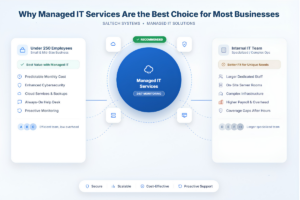
- Under 50 employees, limited budget, need broad coverage → Managed IT Services is usually the more cost-effective and lower-risk choice.
- Highly specialized systems or 250+ employees → An internal team, or a hybrid “co-managed” model, may make more sense.
- Somewhere in between? → Many of our clients are choosing co-managed IT keeping one internal person for institutional knowledge while we handle monitoring, security, and the specialist work.
At Saltech Systems, we work with small businesses across Iowa and Texas including Managed IT Services in Ames and Managed IT Services in Plano to figure out exactly which model fits their size, budget, and risk tolerance. No generic sales pitch, just real numbers based on your actual headcount and setup.
Learn more about our Managed IT Support services, explore our Cybersecurity Services page, or check out our related post on why small businesses need managed IT in 2026 or reach out for a free cost comparison built around your actual team size.
Frequently Asked Questions
1. What are managed IT services?
Managed IT services means outsourcing your company’s day-to-day technology needs network monitoring, help desk support, cybersecurity, backups, and patch management to an outside provider instead of hiring internal staff to handle it all.
2. How much do managed IT services cost per month?
Most small businesses pay a per-user monthly fee that covers help desk support, monitoring, and baseline security. Total cost depends on company size, support hours, and whether compliance requirements apply, but it’s typically far less than the fully loaded cost of one in-house IT hire.
3. Is managed IT cheaper than hiring an in-house IT employee?
For most businesses under 100 employees, yes. A single in-house hire’s fully loaded cost salary, benefits, training, tools usually exceeds what a managed IT provider charges for a full team covering the same responsibilities, plus built-in backup coverage.
4. What’s included in a typical managed IT services plan?
\Most plans include help desk support, around-the-clock or business-hours network monitoring, patch management, data backup, basic cybersecurity protection, and strategic IT planning. Higher tiers often add compliance support and faster response-time guarantees.
5. Can a small business use both in-house IT and managed IT together?
Yes , this is called co-managed IT. An internal employee handles day-to-day, business-specific knowledge while a managed IT partner provides ongoing monitoring, security, and specialist support the internal team doesn’t have. It’s a popular middle-ground option for growing businesses.
Saltech Systems provides Managed IT Services, cybersecurity, web design, and digital marketing for small businesses in Ames, Iowa and Plano, Texas. Contact us for a free IT cost comparison.