
Meta Muse AI: How Small Businesses Can Use Meta’s New AI Agent
AI tools have become very good at answering questions, writing content, and brainstorming ideas. Meta Muse AI takes a different approach: instead of only telling you what to do, it is designed to actually carry out tasks for you.
Meta introduced Muse on September 8, 2026 as a personal AI agent. Powered by Meta’s Muse technology, Muse can browse the web, work with connected apps, create documents, fill out forms, make purchases with approval, and help manage longer-term goals.
For small businesses, that raises an interesting question:
What if AI could do more than help you write an ad and could actually help you complete some of the work behind your marketing?
What Is Meta Muse AI?
Meta Muse is a personal AI agent. The important word here is agent.
A traditional chatbot usually waits for your question, provides an answer, and stops there. Muse is designed to take a goal, break it into steps, use connected tools, and perform actions on your behalf.
For example, instead of asking:
“How should I research my competitors?”
and then doing all the research yourself, you could ask Muse to research selected competitors, organize relevant findings, and prepare information for you to review.
Meta says Muse runs inside a dedicated cloud environment called Muse Secure VM, which has its own browser. Users decide which services Muse can access, and important actions such as sending emails or completing purchases can require approval.
Why Are People Using Meta Muse?
The appeal is fairly simple:
People want AI to save time not become another tool they have to manage.
Generative AI made it easy to create text and ideas. Agentic AI attempts to go a step further by helping complete the actual task.
Muse can research information, work across websites, interact with connected applications, track goals, and continue multi-step work. Meta says users can connect services including email, calendars, Instagram, and other supported apps.
For a small-business owner, that could mean spending less time on repetitive digital tasks and more time on customers, sales, operations, and strategy.
How Can Meta Muse AI Help Small Businesses?
1. Make Competitor Research Faster
Small businesses know they should monitor competitors, but research often gets pushed to the bottom of the list.
Muse can help gather information online, compare options, and organize findings.
A local business could ask:
“Research competing companies offering landscaping services in Dallas. Compare their services, promotions, customer messaging, and advertising angles.”
Instead of starting from a blank page, the business owner gets organized research that can be reviewed before making marketing decisions.
The point isn’t letting AI make every decision.
It is reducing the time required to collect the information behind a better decision.
2. Make Marketing Planning Easier
Imagine telling Muse:
“Research five advertising ideas for our fall promotion. Identify the customer problem each idea solves and create a campaign brief for me to review.”
That can give a small marketing team a stronger starting point.
Muse can also create documents and work with connected tools, making it useful for organizing campaign research, ideas, schedules, and follow-up tasks.
But AI is only one part of the equation.
Successful digital advertising still requires the right audience, offer, landing page, conversion tracking, and ongoing campaign optimization.
3. Generate More Advertising Creative Ideas
This is where Meta’s broader Muse technology becomes especially relevant to advertisers.
Muse Image is Meta’s image-generation model. It can generate and edit visuals through conversational instructions, and Meta has announced that Muse Image is being brought to advertisers through Advantage+ creative.
For a small business without a large design department, AI-assisted creative tools could make it easier to experiment with:
different advertising concepts, product backgrounds, promotional graphics, seasonal creative, visual variations, and social media advertising assets.
Why does that matter?
Because strong Facebook and Instagram advertising usually isn’t about finding one perfect ad.
It’s about testing.
Businesses can test different images, headlines, offers, messaging, and calls to action—and then let performance data show what customers actually respond to.
4. Reduce Everyday Busywork
Marketing doesn’t happen in isolation.
Business owners constantly move between emails, calendars, websites, forms, customer requests, research, and follow-ups.
Muse can work with connected apps including email and calendars and can complete certain multi-step tasks.
That means AI agents could eventually become useful not simply because they generate content, but because they reduce the number of small administrative tasks standing between an idea and execution.
How Should a Small Business Start Using Meta Muse?
Don’t begin by connecting everything.
Start with a low-risk, clearly defined task.
For example:
“Research the questions customers frequently ask about [your service] in [your city]. Group them by search intent and create five Facebook ad concepts and five landing-page content ideas. Do not publish or send anything without my approval.”
That type of request gives the AI a goal while keeping the business owner in control.
As your comfort level increases, you can explore additional workflows and integrations where there is a legitimate business benefit.
Meta says Muse includes permission controls, approval checkpoints, protected credential storage, and an audit trail of its activities. Even with those safeguards, businesses should still follow their own privacy and security policies when deciding what information to connect to any AI system.
Meta Muse AI + Digital Advertising: Where the Real Opportunity Is
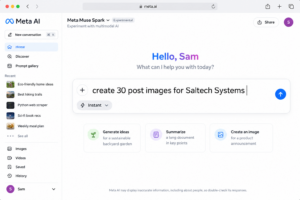
The biggest opportunity isn’t producing hundreds of AI-generated posts simply because you can.
It’s using AI to make better marketing decisions faster.
AI can accelerate research, campaign planning, administrative work, and creative development.
But effective digital advertising still depends on strategy:
reaching the right customer, choosing the right platform, creating the right offer, building landing pages that convert, tracking leads correctly, and continuously optimizing advertising spend.
That’s where AI and an experienced digital advertising strategy can work together.
Saltech Systems’ digital advertising services focus on measurable campaigns across channels such as Google Ads, social media advertising, PPC, retargeting, and local or geo-targeted advertising, with an emphasis on tracking performance and ROI.
Muse may help make parts of the marketing workflow faster.
A strong digital advertising strategy determines what you should do with that speed.
AI can help businesses move faster. The objective remains the same:
Turn attention into clicks. Turn clicks into leads. And turn leads into customers.
Learn more about Saltech Systems Digital Advertising Services
FAQs About Meta Muse AI
1. What is Meta Muse AI?
Meta Muse is a personal AI agent created by Meta. Unlike a standard chatbot that mainly answers questions, Muse can browse the web, use connected services, create documents, perform tasks, and work toward longer-term goals.
2. How is Meta Muse different from a chatbot?
A chatbot primarily provides information or generates content. Muse is designed to go further by using tools and completing multi-step actions on the user’s behalf, subject to permissions and approvals.
3. Can small businesses use Meta Muse for marketing?
Muse can potentially help small businesses with research, competitor analysis, campaign planning, organizing information, brainstorming content, and administrative workflows. Businesses should still review AI-generated work before using it publicly.
4. Can Meta Muse create images for Facebook and Instagram ads?
Meta’s related Muse Image model generates and edits images. Meta has announced that Muse Image capabilities are coming to advertisers through Advantage+ creative.
5. Is Meta Muse safe for business information?
Meta says Muse uses a dedicated Secure VM, permission controls, protected credentials, approval checkpoints, and activity auditing. Businesses should still limit access to what is necessary and follow their own data-security policies.