
Mobile app development services help businesses plan, design, build, launch and maintain apps for iPhone and Android. At Saltech Systems, our mobile app development team builds custom iOS, Android and cross-platform apps from our offices in Ames, Iowa, and Plano, Texas. This guide explains what healthcare, law firm and ecommerce apps need, and how we help business owners build them the right way.
Bottom line up front: A successful business app starts with a clear goal, the right platform choice and the rules for your industry. Healthcare apps must protect health data under HIPAA or the FTC Health Breach Notification Rule. Law firm apps must protect client confidentiality. Ecommerce apps must follow Apple and Google payment rules. Every app needs a privacy policy, in-app account deletion if users create accounts, strong security and a plan for updates after launch. Saltech Systems handles all of this in four clear steps.
What mobile app development services include
What are mobile app development services?
Mobile app development services cover every step of creating an app, from the first idea to ongoing updates.
A full-service team handles:
- Planning, scope and requirements
- User experience (UX) and interface design
- Development for iOS, Android or both
- Back-end systems, databases and integrations
- Testing, security and app store submission
- Maintenance, updates and support
How Saltech helps: We do all of this in one place. Our designers and developers work side by side, so the app looks good and works well. We also offer hosting, cybersecurity and marketing, so you don’t need separate vendors.
Native, cross-platform or website-to-app: which is right?
The right approach depends on your users, your features and your timeline.
| Approach | What it means | Best for |
|---|---|---|
| Native iOS and Android | Separate apps built for each platform | Apps that need top performance or deep device features |
| Cross-platform | One shared codebase for iPhone and Android | Most business apps that need both platforms |
| Website-to-app | Turning your existing website into an optimized mobile app | Businesses with a strong website that want an app presence |
| Web app | A mobile-friendly app that runs in a browser | Internal tools or a first version before a store app |
How Saltech helps: We build native iOS, Android and cross-platform apps. We can also expand your existing website into an optimized mobile app. Our team works with modern tools such as React, Node.js, Python, PostgreSQL, MySQL, MongoDB, AWS, Microsoft Azure and Google Cloud. Learn more about our custom app development.
What features do business apps need?
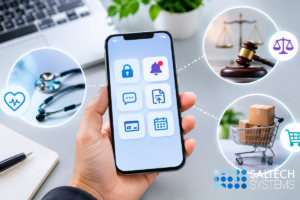
Most business apps share a core set of features, plus a few that depend on the industry.
| Feature | Healthcare app | Law firm app | Ecommerce app |
|---|---|---|---|
| Secure login and accounts | ✓ | ✓ | ✓ |
| Push notifications | Appointment reminders | Case updates | Order and sale alerts |
| Secure messaging | Patient–provider | Client–attorney | Customer support |
| Document or photo upload | Forms, insurance cards | Case documents | Returns, reviews |
| Payments | Copays, bills | Retainers, invoices | Checkout, Apple Pay, Google Pay |
| Scheduling | Appointments | Consultations | Pickup or delivery times |
| Integrations | EHR systems | Practice management tools | Shopify, WooCommerce, inventory |
| Accessibility | ✓ | ✓ | ✓ |
Why your industry changes how an app is built
What does a healthcare app need?
A healthcare app must protect health information, and the rules depend on who runs the app.
- HIPAA: If your app is run by or for a covered entity, such as a clinic, or a business associate, the HIPAA Security Rule applies. It requires administrative, physical and technical safeguards for electronic health information (HHS). Vendors that handle that data usually sign a business associate agreement (BAA).
- FTC Health Breach Notification Rule: Many consumer health apps are not covered by HIPAA. The FTC says its rule “applies to health apps and similar technologies not covered by HIPAA.” Since 2024, a breach includes unauthorized disclosures, not just hacks (FTC).
- Apple’s health rules: Apple does not allow health data from HealthKit to be used for advertising or marketing. Apps may not store personal health information in iCloud.
- Integrations: Many healthcare apps connect to electronic health records (EHR), often through the HL7 FHIR standard.
This is general information, not legal advice. Confirm your obligations with a compliance advisor.
How Saltech helps: We build healthcare apps with encryption, secure authentication and security audits. We also back them with our cybersecurity services and data backup and recovery, all with one team.
What does a law firm app need?
A law firm app must protect client confidentiality first and add convenience second.
Attorneys must protect client information under rules such as ABA Model Rule 1.6. A law firm app usually needs:
- A secure client portal with strong login protection
- Encrypted messaging between clients and attorneys
- Secure document upload and download
- Case status updates and appointment scheduling
- Secure payment of retainers and invoices
- Clear records of who accessed what, and when
How Saltech helps: We design law firm apps around security and simplicity. Clients get an easy way to stay informed. Attorneys get tools that protect confidential information. Because we also provide managed IT and cybersecurity, your app and your office systems can be protected together.
What does an ecommerce app need?
An ecommerce app must make buying fast, safe and easy on a small screen.
- Fast checkout with saved carts, Apple Pay and Google Pay
- Product sync with your store, such as Shopify or WooCommerce
- Push notifications for abandoned carts, sales and order updates
- Order tracking and easy returns
- Reviews and product search
Payment rules matter. Apple’s App Review Guideline 3.1.3(e) says apps that sell physical goods or services used outside the app must use payment methods other than Apple’s in-app purchase, such as Apple Pay or credit card entry. Digital goods and features unlocked inside the app generally must use in-app purchase.
How Saltech helps: We build ecommerce apps that connect to your store and inventory. Our e-commerce web design team keeps your website and app working as one system.
Why do Apple and Google rules matter before you build?
App store rules shape your design, so plan for them from day one.
Apple’s App Review Guideline 5.1.1 requires two things that first-time app owners often miss (Apple App Review Guidelines):
- A privacy policy. “All apps must include a link to their privacy policy” in the App Store listing and inside the app.
- Account deletion. “If your app supports account creation, you must also offer account deletion within the app.”
Google Play has its own policies on data safety, permissions and payments. Building these rules in early avoids rejected submissions and launch delays.
How Saltech helps: We plan for Apple and Google requirements during design. We then handle testing and app store submission, so your launch stays on schedule.
How to plan, build and launch your app
How does Saltech’s 4-step process work?
We follow four clear steps, with weekly progress reports throughout.
- Understanding your goals. We meet with you to define scope, requirements, the problem your app solves and a release schedule.
- Planning for success. We create a work breakdown structure and choose technology that can scale as you grow.
- Build, test, review and revise. We use version control, peer review and testing during development. You see progress and give feedback along the way.
- Deliver, launch and maintain. We review the app with you in a staging environment, launch it and provide ongoing maintenance.
What should you decide before development starts?
Answer these 8 questions before you talk to any developer.
- What one problem will the app solve for your customers or clients?
- Who will use it: patients, clients, shoppers or staff?
- Do you need iPhone, Android or both?
- Which features are must-haves for version one?
- What data will the app collect, and which rules apply to it?
- Which systems must it connect to, such as an EHR, case management tool or online store?
- Who will manage content, updates and support after launch?
- How will you measure success: downloads, bookings, sales or time saved?
How do you choose a mobile app development company?
Score each company from 1 (poor) to 5 (excellent).
| Question | Company A | Company B |
|---|---|---|
| Do they build for iOS, Android and cross-platform? | ___ | ___ |
| Do designers and developers work together? | ___ | ___ |
| Do they understand your industry’s data rules? | ___ | ___ |
| Do they plan for Apple and Google requirements? | ___ | ___ |
| Do they test and peer-review their code? | ___ | ___ |
| Do they send regular progress reports? | ___ | ___ |
| Do they offer maintenance after launch? | ___ | ___ |
| Will you own the code, accounts and app store listings? | ___ | ___ |
| Total (out of 40) | ___ | ___ |
32 or higher is a strong fit. Below 24 is a warning sign.
What red flags should you avoid?
Walk away from any developer that skips planning or keeps control of your app.
- No discovery phase. Jumping straight to code leads to rework.
- No talk of data rules. Healthcare and law firm apps need security planning from day one.
- No testing or code review. Bugs reach your users instead of being caught early.
- The developer owns your app store accounts. Your business should own its Apple and Google developer accounts.
- No plan after launch. Apps need updates for new phone software, security patches and store policy changes.
What happens after launch?
Launch is the beginning, not the end.
- Updates: Apple and Google release new operating systems every year.
- Security: Patches keep your app and your users’ data safe.
- Store policies: Apple and Google rules change, and apps must keep up.
- Growth: User feedback shapes new features.
- Marketing: People need to find your app.
How Saltech helps: We provide ongoing maintenance after launch. We can also host your app’s back end on our web hosting and help people find your app through digital advertising.
Why business owners choose Saltech Systems
One team for your app, your website, your security and your marketing.
- Since 2004. We have helped businesses with technology for more than 20 years.
- Functional code. We write efficient, quality code that avoids breakdowns.
- Sleek design. Our designers and developers work together on every screen.
- On time and within budget. We commit to your timeline and budget goals.
- Weekly progress reports. You always know where your project stands.
- Full technology partner. App development, web design, hosting, cybersecurity, managed IT, website accessibility and marketing under one roof.
- Local offices. Teams in Ames, Iowa, and Plano, Texas.
Planning a healthcare, law firm or ecommerce app? Talk to our team about your goals, your users and your timeline. We will give you clear, honest answers, with no pressure.
Contact Saltech Systems · Ames (515) 520-8200 · Plano (972) 905-1001
Frequently asked questions
1. What do mobile app development services include?
Mobile app development services include planning, design, development for iOS and Android, back-end systems, integrations, testing, app store submission and ongoing maintenance. Saltech Systems handles all of these steps with one team.
2. Should I build a native or cross-platform app?
Choose native when your app needs top performance or deep device features. Choose cross-platform when you need both iPhone and Android and want one shared codebase. Many business apps work well as cross-platform apps.
3. Does my healthcare app need to follow HIPAA?
It depends on who runs the app. Apps run by or for covered entities, such as clinics, and their business associates must follow HIPAA. Many consumer health apps are covered by the FTC Health Breach Notification Rule instead. Check with a compliance advisor.
4. How do law firm apps protect client information?
Law firm apps protect client information with secure logins, encrypted messaging, secure document upload and access records. These features help attorneys meet confidentiality duties, such as ABA Model Rule 1.6.
5. Can my ecommerce app use Apple Pay instead of Apple’s in-app purchase?
Yes, for physical goods. Apple’s guidelines say apps that sell physical goods or services used outside the app must use methods other than in-app purchase, such as Apple Pay or credit card entry. Digital content unlocked in the app generally must use in-app purchase.
The right mobile app development services plan for your industry’s rules before writing a single line of code.
Start with one clear goal. Choose the right platform. Protect health data, client information and payments from day one. Build in Apple and Google requirements early. Plan for updates after launch. Saltech Systems brings design, development, security, hosting and marketing together, so your app is built right and stays that way.
Ready to build your business app?
Talk to our app development team · Ames (515) 520-8200 · Plano (972) 905-1001
Learn more about our mobile app development services.